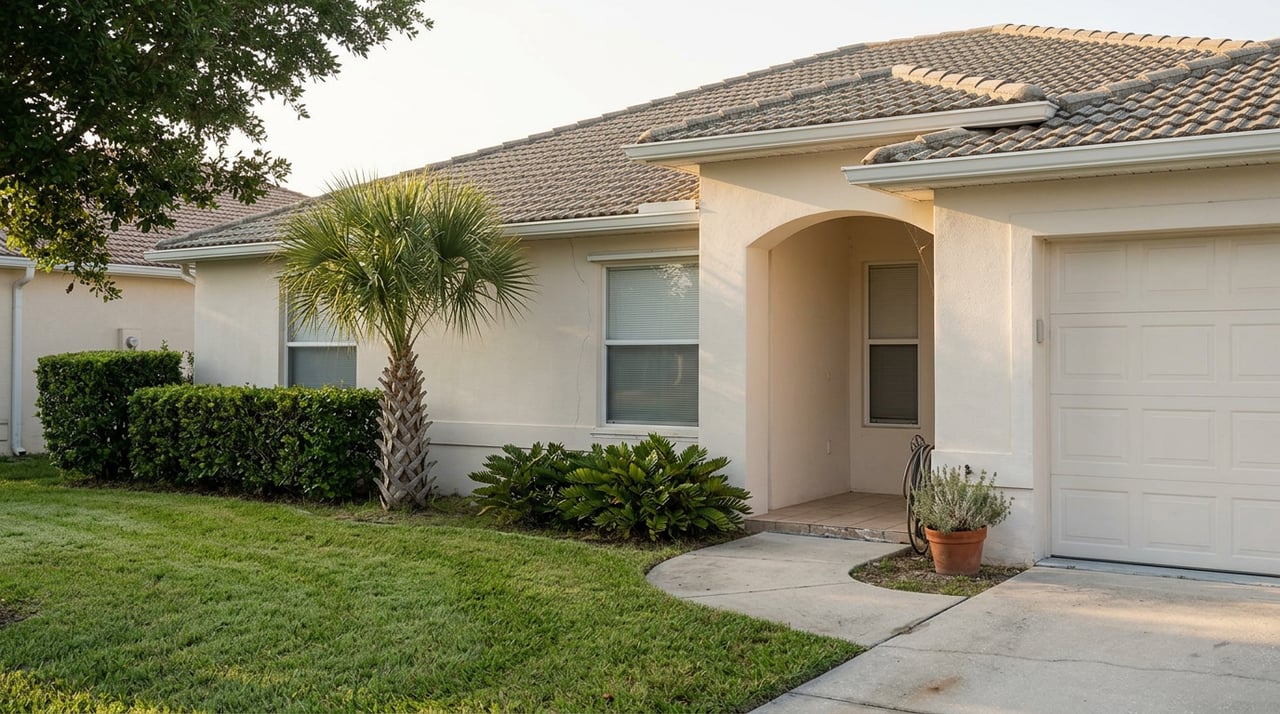
In The Villages, Two Homes at the Same Price Aren't the Same Deal
August 27, 2026
August 27, 2026
Pull up two listings in The Villages priced at $350,000. Same square footage, same three-bedroom layout, same golf cart ride to a town square. On paper, they look interchangeable. At closing, they might not be.
One of those homes could carry a bond balance north of $30,000 that transfers straight to the new owner's property tax bill. The other might already say "bond paid" in the listing remarks, meaning that cost was settled years ago and the new buyer owes nothing on it. Same price tag. Different total bill. As of mid-August 2026, current MLS listings in villages like Woodbury and Mission Hills still lead with "bond paid" in all caps, because agents and sellers know it changes what a buyer is actually agreeing to pay.
This is the piece the median price can't tell you. And in a community built section by section over four decades, it's the number that actually decides what a home costs.
The Villages is organized into 17 separate Community Development Districts, special-purpose local governments created under Florida Statute Chapter 190 to finance and manage infrastructure for a defined area. When the developer builds out a new section, roads, water and sewer lines, streetlights, and recreation amenities get paid for upfront through bonds issued by that district. The homeowners in that section then repay the bond over time, similar to how a city might assess residents for a new sidewalk or sewer line, except the dollar figures here are much larger because the infrastructure includes entire road networks and recreation centers.
Those bonds are typically financed over 25 years at a fixed interest rate set when the bond was issued, anywhere from roughly 3 percent to 7 percent depending on when that section was built. They don't get refinanced. Whatever rate and term a section locked in years ago is the rate and term every subsequent owner inherits until the balance is paid off.
That's the part that catches buyers off guard. A CDD bond isn't a personal loan tied to the original buyer. It's attached to the parcel. When a home resells, the remaining balance goes with it. Florida law requires sellers to disclose the current balance, but the number never appears in the list price itself. It shows up on the property tax bill as a separate line item, due each November.
Bond balances aren't random. They track two things: when a section was built and how far south it sits.
Villages built in the 1980s and early 1990s, generally north of County Road 466, have had decades to pay their bonds down. Many carry minimal balances or none at all. Homes in the more established resale core, built through the 2000s and early 2010s, sit in a wider range because balances depend on how aggressively a given owner paid theirs down. And the newest expansion sections, including Fenney and the still-developing Eastport area, carry the highest balances in the community. It's not unusual for a resale home in one of these newer sections to carry $20,000 to $40,000 or more in remaining bond debt, on top of whatever the buyer pays for the house itself.
Here's roughly how that breaks down by category:
| Section type | Typical build era | Bond balance on resale |
|---|---|---|
| Original northern villages | 1980s–early 1990s | Often paid off or minimal |
| Established resale core | 2000s–early 2010s | Wide range, verify per property |
| Newer expansion sections (Fenney, Eastport) | 2010s–present | Commonly $20,000–$40,000+ |
Two homes priced identically at $350,000 could sit at opposite ends of that table. One buyer inherits a paid-off infrastructure assessment. The other takes on a five-figure obligation that shows up every November for years. Neither price was wrong. They were just measuring different things.
The bond is also separate from the monthly amenity fee, sometimes called the Lifestyle Fee, which covers access to pools, golf, and recreation centers rather than infrastructure. That fee runs around $195 to $204 a month for new buyers as of early 2026 and adjusts over time based on the home's first transfer date. It's a real cost, but it's the same for every buyer moving in today. The bond is the one that varies wildly from parcel to parcel.
Ask three different sources what a home in The Villages costs right now and you'll get three different answers. Over the three months ending in May 2026, the median sale price came in around $355,000, down about 2.3 percent from a year earlier. A separate average-value estimate as of the end of June 2026 put the figure closer to $392,945, down 1.8 percent year over year. Another source pegged the June 2026 median at $359,900, down a smaller 0.58 percent.
None of these numbers are wrong. They're measuring slightly different things: medians versus averages, single-family homes versus a blend that includes condos and villas, different rolling windows. But the spread between them, nearly $40,000 depending on which figure you read, makes the same point as the bond math. A single headline price tells you almost nothing about what a specific home will actually cost you to own. The community is too varied, and the financing structure underneath it is too specific to each parcel, for one number to carry the whole story.
Here's where the timing works in a buyer's favor. As of early August 2026, buyers in The Villages were negotiating roughly 7 percent off asking price on average, in a market one local analysis scored as balanced rather than tilted toward sellers. That negotiating room doesn't only apply to the sale price.
When a market favors buyers even modestly, sellers become more willing to pay off a remaining bond balance as part of closing rather than let it kill a deal. A seller sitting on a $28,000 bond balance in a slower market has real incentive to offer "bond paid" as a selling point, especially when comparable homes down the street already advertise that status. In a tighter, faster market, that same seller might hold firm and let the buyer absorb the balance. The negotiating leverage buyers have gained recently isn't just about the price on the sign. It's about who ends up owning that infrastructure debt.
Before making an offer on any home in The Villages, get answers to these in writing:
The remaining balance and annual payment amount are public record. A title company or the relevant CDD office can confirm the exact figure before you're locked into a contract.
Is the bond the same thing as an HOA fee? No. The Villages doesn't use a traditional HOA. The bond is a government infrastructure assessment tied to a specific Community Development District, while the amenity fee is a separate monthly charge for recreational access. They appear on different bills and serve different purposes.
Does paying off the bond early save money? It can, since bonds carry a fixed interest rate that doesn't change over the life of the loan. Whether early payoff makes sense depends on that rate, the remaining term, and what else that cash could do for the buyer. It's a math question specific to each parcel, not a blanket rule.
Do all resale homes carry a bond? No. Homes in the oldest sections, generally built before the mid-1990s, frequently have no remaining bond at all. Newer sections almost always do until an owner pays it off, which is why the balance needs to be verified property by property rather than assumed from the neighborhood's reputation.
The bond system is exactly the kind of detail that separates a comfortable move from an expensive surprise. If you're comparing homes in The Villages, or trying to figure out what a listing price actually includes once the district assessment and amenity fee are factored in, Palm & Pine Collective can walk through the real numbers on any specific property before you make an offer. Reach out for a free home valuation and a clear read on what a given home will actually cost to carry.
Stay up to date on the latest real estate trends.
Grow your career within a collaborative, mentorship-driven environment focused on integrity, education, and sustainable success.