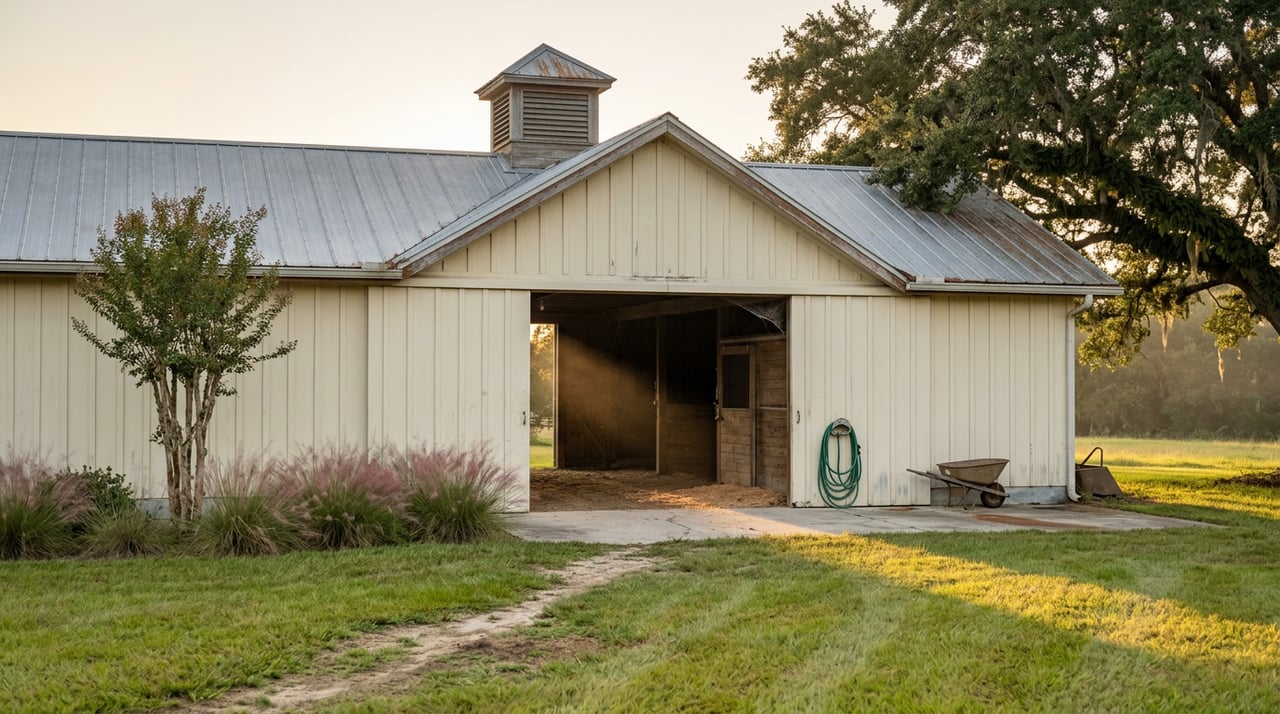
Ocala Horse Country in 2026: Why Raw Land Cooled While Turnkey Farms Keep Selling for Millions
August 13, 2026
August 13, 2026
On April 15, a ten-acre property on NW 21st Street in Ocala's Kimberwood Farms subdivision closed for $4 million. A 10-acre horse farm with a professional wood-fired pizza oven and several other upgraded amenities was sold for $4 million in Ocala's premiere equestrian corridor, located at 7268 NW 21st Street in the Kimberwood Farms subdivision. The grounds include six lush paddocks shaded by oak trees, a three-acre irrigated turf riding field, a new jump arena with GGT footing, a full show jumping course, a new GGT footing round pen, a six-horse EuroWalker, two automatic gated entrances, and a trailer parking area with RV hookups. The listing even leaned on the property's location, boasting that it is within golf cart distance of the World Equestrian Center.
That sale looks like proof of the story every Ocala horse-country buyer has already heard: land near WEC only goes up. But a report covering the same corridor, published that same spring, found something the golf-cart-distance headline doesn't capture. Large raw parcels around the venue actually lost value in 2025. Both things are true at once, and the gap between them is exactly what a buyer or seller needs to understand before writing an offer on anything with acreage attached.
Since the World Equestrian Center hosted its first show in December 2020, the story around Marion County land has been simple: proximity to the venue prints money. A study called "The WEC Effect," produced by Ocala brokerage SVN McDonald & Company, put real numbers behind that story. The report analyzed more than 300 land transactions to assess the center's impact on Marion County land values. Between six and nine miles from WEC, vacant land values surged by an astonishing 325 percent. Across an average parcel size of 54.57 acres, 2023 prices ranged from $10,974 per acre at the low end to $143,117 per acre at the high end.
"The World Equestrian Center has been a game-changer for land values in the area," said Bartow McDonald, managing director of SVN McDonald & Company. "We've seen a remarkable surge in demand for land near the WEC."
That quote, and that report, have circulated on nearly every horse-property page in Central Florida for two years. It's not wrong. It's just no longer the current chapter.
A follow-up look at the same "WEC Effect" data, reported in early April, told a different story about the most recent year on record. A market report called "The WEC Effect" found that land values of large parcels of property around the World Equestrian Center declined in 2025. SVN McDonald measured land values at different distances up to 18 miles from WEC, and prices dropped across the board last year. Real estate prices as a whole were flat across Marion County in 2025, according to Florida Realtors.
So the same firm that documented the boom also documented the pullback. Raw acreage, the kind investors were buying by the dozens of acres on the strength of a per-acre appreciation chart, cooled off. Meanwhile finished, livable, ride-today farms kept closing at prices that would suggest nothing had slowed down at all.
Look at what actually sold near WEC in the months since that decline was reported, and the split becomes obvious.
| Property | Acreage | Sale Price | Closed | Approx. price per acre |
|---|---|---|---|---|
| Kimberwood Farms, NW Ocala | 10 acres | $4,000,000 | April 15, 2026 | ~$400,000 |
| Southwest Ocala estate | 10 acres | $1,325,000 | June 26, 2026 | ~$132,500 |
| Fort McCoy, NE Marion | 24.16 acres | $1,450,000 | April 6, 2026 | ~$60,000 |
| Morriston, west Marion | 60.8 acres | $4,450,000 | April 22, 2026 | ~$73,000 |
| Indian Prairie Ranch portion | 85 acres | $1,500,000 | March 10, 2026 | ~$17,650 |
The pattern isn't distance from WEC. It's how finished the property is. The smaller, fully built-out farms with barns, arenas, and a house you could move into that afternoon are trading at multiples of what the larger, more raw acreage commands per acre, even when the raw acreage sits closer to the venue on paper.
The southwest Ocala sale makes the point cleanly. Marion County property records indicate that the Yates family previously purchased the farm for $800,000 from Robert and Mary Moore in April 2021. They sold it for $1.325 million five years later, a gain of roughly 66 percent on a fully equipped ten-acre farm with five individual paddocks and a four-stall, center-aisle barn that includes a built-in one-bedroom, one-bathroom apartment. That's appreciation on a finished product, not on bare dirt.
The Morriston sale tells the other half of the story. An equestrian who competed in the most recent Summer Olympics sold her nearly 61-acre compound in the western part of Marion County for $4.45 million to a Chicago-based real estate investment firm. The buyer wasn't a hobbyist chasing a horse farm. It was an out-of-state investment company evaluating a large, working equestrian asset on its own terms, at roughly $73,000 an acre for a property with a 13-stall barn already on it. That's a different kind of buyer than the one the 2023 headline numbers were written for.
The properties still moving quickly and at strong prices share a common feature: someone else already did the work. Barns are built. Footing is installed. Fencing is up. A buyer writing a check for a place like Kimberwood Farms or the Fort McCoy property, where outdoor amenities include an in-ground, diving-depth swimming pool and a landscape scattered with oak trees, along with a 275-foot well and buried electric lines with three separate meters, is paying for certainty. They know what they're getting the day they close.
Raw acreage asks the buyer to take on that risk themselves, and in 2025 fewer buyers were willing to pay 2023-level premiums to do it. That's the mechanism behind the decline SVN McDonald documented. It isn't that Marion County horse country lost its appeal. It's that the market re-priced the difference between land with potential and land with a finished product already standing on it.
If you're holding acreage that hasn't been built out, price it against 2025 raw-land comps, not the finished-farm sales making headlines. A buyer's agent working an equestrian client will know the difference between a $4 million turnkey estate and a $17,650-per-acre historic parcel, and pricing bare land as if it belongs in the first category will slow your sale rather than speed it up. Sometimes the more effective move is investing in basic improvements before listing, since the market has shown it will pay a real premium for a property a buyer can use immediately.
Does being close to the World Equestrian Center guarantee a property will keep gaining value? Not on its own. Proximity mattered enormously during the boom years, but the 2025 data shows raw land near the venue can still lose value even while finished farms in the same radius continue to sell well. Location sets the ceiling. Condition determines whether a property gets anywhere near it.
Is the broader Ocala housing market still growing in 2026? The horse-property submarket and the general residential market are moving on different tracks right now. Countywide, residential prices were flat through 2025, while the equestrian segment split between a cooling raw-land tier and a strong turnkey-farm tier.
What venues besides WEC should factor into a horse-property search? HITS and the Florida Horse Park both draw buyers who want to be within a short trailer ride of competition grounds, not just close to WEC itself. Several of the largest 2026 sales referenced proximity to more than one venue, which is worth factoring into how you weigh a parcel's location.
If you're weighing a horse property in Marion County this year, the math is rarely as simple as a per-acre average suggests. Palm & Pine Collective works with equestrian buyers and sellers across Ocala, Dunnellon, and the surrounding Nature Coast, including agents like Dee Tripp, who brings decades of horse-farm expertise to exactly this kind of pricing question. If you're trying to figure out what your land or your finished farm is actually worth in today's market, reach out for a free home valuation before you set a number.
Stay up to date on the latest real estate trends.
Grow your career within a collaborative, mentorship-driven environment focused on integrity, education, and sustainable success.